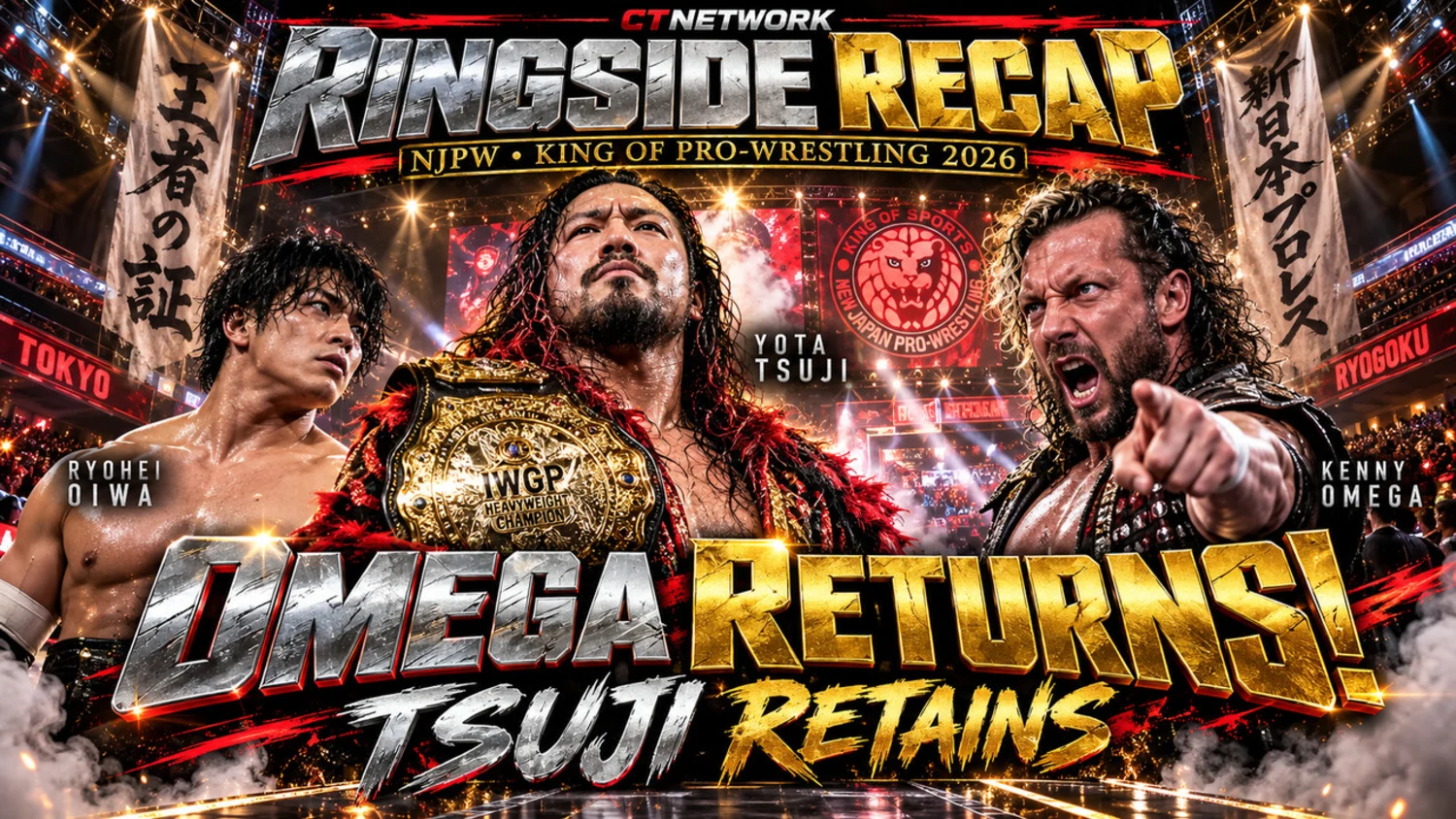
Tsuji retained the IWGP Heavyweight Championship at King of Pro-Wrestling, only for Kenny Omega and Boltin Oleg to move directly into the title picture.
One win, two new problems
Yota Tsuji beat Ryohei Oiwa in the October 12 King of Pro-Wrestling main event, retaining the IWGP Heavyweight Championship after a hard-fought contest in Tokyo. The victory should have offered the champion a moment to celebrate. Instead, the closing angle put the belt — and the identity of the company around it — under fresh scrutiny.
Kenny Omega appeared first by video to make his intentions clear, then appeared in person and attacked Tsuji and Boltin Oleg. The order of those events was part of the impact. It positioned Omega as more than a returning visitor and framed the title picture as a collision between the company NJPW has become and a performer closely associated with a previous era.
Why Omega's return is a story about New Japan itself
Omega's history in New Japan gives this program a built-in emotional argument. His fame is tied to the promotion's international expansion and to a generation of major matches that helped define its global reputation. Tsuji represents a more current group of wrestlers trying to build the company's next identity. That contrast can make even an ordinary face-to-face confrontation feel consequential.
The danger is that nostalgia could swallow the champion. Tsuji won the main event and has earned the right to be treated as the center of the story. A strong build would let Omega challenge him without suggesting that the present-day roster is merely waiting for the past to return. The most convincing outcome for NJPW is a feud in which Tsuji has to prove himself, not one in which he becomes background scenery for an established star.
Do not overlook Boltin Oleg
Oleg's presence changes the geometry of the rivalry. A one-on-one Omega–Tsuji setup is easy to understand; adding another credible wrestler makes the contest for position more uncertain. POST Wrestling reported Omega proposed a non-title three-way for November 3 at Power Struggle in Hiroshima, with the idea that winning could strengthen a future championship claim. That was a proposal in reported backstage comments, not a guarantee that the match had already been formally booked.
That distinction is important because the story is still developing. If the proposed scenario goes ahead, the match could test Tsuji without forcing an immediate title defense. It could also create an opening for Omega and Oleg to develop an issue of their own. Either route gives NJPW more room to build toward its next major destination.
A champion's biggest task is keeping the spotlight
Oiwa pushed Tsuji over a lengthy main event and emerged with valuable credibility despite the loss. Omega's attack then ensured the conversation would shift almost instantly to the title holder's future. Tsuji now has to carry both ideas at once: he must look like a champion capable of surviving top challengers, and he must project enough personality to stand beside the returning Omega without disappearing.
The story to watch is not merely whether Omega receives a championship opportunity. It is whether Tsuji can emerge from the entire program as the focal point of New Japan's next chapter. That is a more meaningful test than the result of any single match.
FACT CHECK / SOURCE REPORTING
WATCH THE RINGSIDE VIDEO
NJPW King of Pro-Wrestling 2026 — Ringside full recap
WATCH ON YOUTUBE ↗