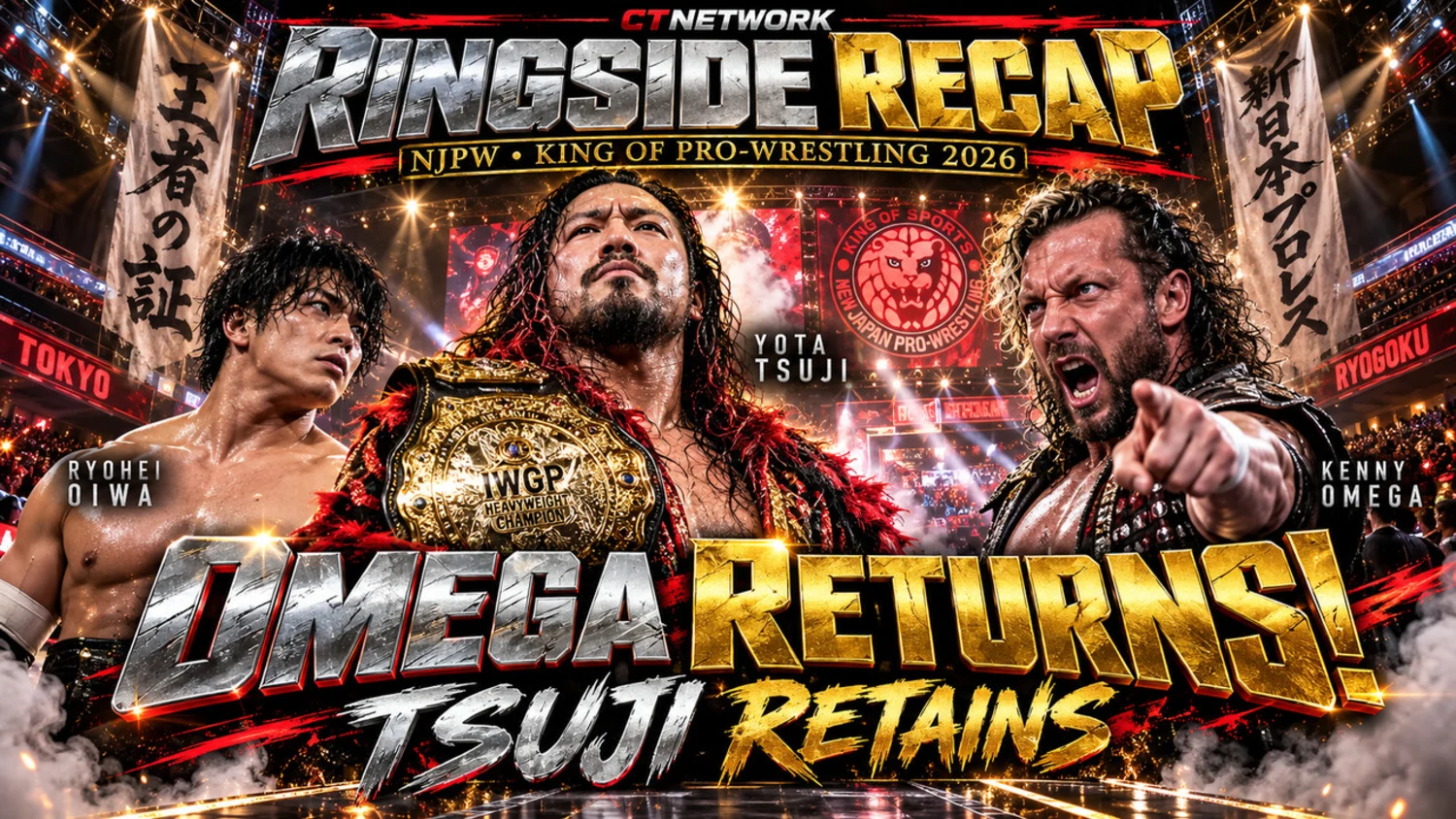
Kenny Omega, Will Ospreay and Jon Moxley are confirmed for a loaded November 3 card. The bigger story is how New Japan turns visiting stars into momentum for its own champions.
The card has become an argument about New Japan's future
Power Struggle on November 3 in Hiroshima was already important as New Japan approaches its next Wrestle Kingdom season. The newly confirmed matches give it an additional identity: an event where wrestlers associated with AEW step directly into the programs that NJPW has been building around its own championships. Kenny Omega, Will Ospreay and Jon Moxley are not simply making ceremonial appearances. Each has been placed in a situation with a consequence for a New Japan wrestler, a title, or both.
That is the opportunity and the risk. Outside star power can attract additional interest, especially from fans who follow more than one promotion. But a successful crossover should leave the home company's roster better positioned than before. NJPW has to avoid making its champions feel like supporting characters in somebody else's reunion. The results in Hiroshima will matter, yet the creative choices leading into and out of those results may matter even more.
Omega versus Tsuji versus Boltin Oleg is bigger than a return match
Kenny Omega's surprise appearance at King of Pro-Wrestling followed Yota Tsuji's successful IWGP Heavyweight Championship defense against Ryohei Oiwa. Omega challenged Tsuji, then attacked both the champion and Boltin Oleg. The three-way proposal that followed has now become an officially announced Power Struggle match. Reporting on the confirmed card says an Omega victory earns him a future opportunity at the heavyweight title. This is not itself an IWGP Heavyweight Championship defense, an important distinction when looking at what each participant stands to gain.
The obvious attention falls on Omega, whose history in NJPW makes a return to its heavyweight title picture feel significant. But Tsuji has more to prove than whether he can survive an attack from an established legend. He has to project the confidence of the promotion's present-day leader while other recognizable names circle the belt. Oleg's inclusion helps prevent the program from becoming only a past-versus-present nostalgia exercise. It introduces another wrestler with his own interests, and therefore another route for the rivalry to develop after November 3.
Ospreay and Callum Newman's alliance has a built-in fault line
Another championship match pairs Will Ospreay with Callum Newman against IWGP Tag Team Champions Yuto-Ice and OSKAR, the Knock Out Brothers. On paper, the United Empire challengers have considerable individual credibility. The more interesting question is whether their partnership is as stable as that talent suggests. Recent New Japan storylines have emphasized tension between Ospreay and Newman over leadership and direction within the group.
A tag-team title challenge is an effective place to test that relationship. Championship stakes mean one miscommunication could change much more than the outcome of a single match; it could also widen the division between two wrestlers who must cooperate to win. At the same time, the champions deserve to be presented as genuine obstacles rather than convenient props for an internal United Empire argument. If the Knock Out Brothers retain, the story should highlight their strengths. If Ospreay and Newman win, the bigger question becomes whether shared gold genuinely repairs their differences.
Moxley's return can elevate the opponents across the ring
Jon Moxley is also booked for Hiroshima, teaming with fellow Death Riders member Wheeler Yuta against Jeff Cobb and Shingo Takagi. That announcement follows the confrontation teased at King of Pro-Wrestling, when Moxley responded to Takagi's provocation. It gives the event another recognizable crossover pairing, but the appeal is not limited to the international names. Takagi and Cobb have the kind of distinctive offensive styles that can make the match feel different from the rest of the card.
Good crossover wrestling should work in both directions. An AEW viewer who arrives for Moxley ought to leave with a stronger sense of why Takagi matters. A long-time NJPW viewer should see the visiting team treated as a serious competitive threat, not a passing cameo. That is why match structure and follow-up are so important. A competitive fight can create new issues regardless of who gets the fall, while a one-night appearance with no lasting narrative consequence leaves very little behind.
The road to Wrestle Kingdom needs clear winners beyond November 3
The announced card also includes Gabe Kidd defending the IWGP Global Heavyweight Championship against Taichi and the Super Junior Tag League final. Those matches are essential reminders that Power Struggle is still an NJPW event with multiple divisions and ongoing stories of its own. The promotion is not simply staging an AEW showcase. Its junior-heavyweight league and other title programs need meaningful space on the night as well.
The best-case outcome is a show that gives fans several reasons to return. Omega's three-way can clarify the heavyweight challenger's path. The United Empire tag match can advance both championship stakes and an unstable partnership. Moxley's match can make a future encounter with Takagi feel inevitable without announcing something that has not been booked. Our Ringside read is that Power Struggle will succeed if the AEW connection brings people to the show and NJPW's own wrestlers give them a reason to stay. The November 3 card now has that potential; execution is what will decide it.
FACT CHECK / SOURCE REPORTING
WATCH THE RINGSIDE VIDEO
Related Ringside Recap: King of Pro-Wrestling 2026, the show that set up these Power Struggle matches
WATCH ON YOUTUBE ↗